Posts

Lublin: A Special Place
Image
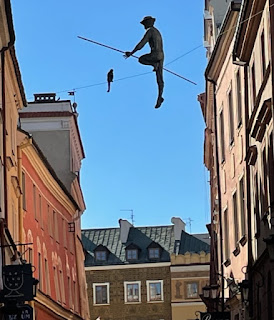
  "The Magician of  Lublin ," famous book by Isaac Bashevis Singer depicted on this display in the Old Quarter. Lublin   is a special place for us. We have been staying here for a week and I feel strongly the presence of my mother and her family in this place. This especially came home to me when Carol discovered a photograph of my mother in an extraordinary cache of pre-war photos of Jewish Lubliners (in the photo perhaps also my grandmother and uncles). The photos were discovered during renovation of an Old Town house, which turned out to be a Jewish photographer’s studio, and have been lovingly preserved and shared with the world by Brama Grodzka (see more on Brama below). My grandmother’s family – Wajcenbrodt – was also from   Lublin . My grandfather – Chaim Boruch Hochberger – was from a nearby town – Łęczna, which we also visited. It was about 2/3 Jewish before the War (2,500 Jews).    My mother was born in the Jewish hospital built by the community i...

Białystok Ghetto Revolt

Image
    Map of Jewish Armed Resistance in Poland Jewish resistance and uprisings against the Nazis took place at numerous locations throughout Poland, including in about 100 ghettos, labor camps and killing centers. The odds against success were significant and Nazi retaliation vicious.    Besides the Białystok, Warsaw, Minsk and other ghetto uprisings, there was resistance and uprisings in some Nazi concentration camps including  Kruszyna (1942), Minsk Mazowiecki (1943), and Janowska (1943), among others. In several dozen camps, prisoners organized escapes to join partisan units.    There were also Jewish revolts in the killing centers of Treblinka, Sobibor and Auschwitz.  At Treblinka in August 1943 and Sobibor in October 1943, prisoners stole weapons and attacked the SS staff and guards. Several dozen prisoners eluded their pursuers and survived the war. In October 1944 at Auschwitz-Birkenau, members of the Jewish Special Detachment ...

Searching for my Cousin's Grave

Image
Żabno Cemetery - some Matzevot standing, some disturbed, some missing. On our trip we visited the Jewish Cemetery in Żabno. We were drawn there because our guide thought it possible that relatives of my grandmother were buried there. Specifically, he wondered, based on his genealogical research, whether Yitzhak Fenichel,  her  nephew (hence my cousin once removed), was there.    Żabno is not far from Przeclaw (Feuer home) and Kolbuszowa (grandmother [Fenichel's] birthplace). Before the War there were 600 Jews there, about 50 percent of the town’s population. The Nazis had a labor camp nearby, and it’s possible Yitzhak may have been forced to work there before he was murdered back in Żabno.    Yitzhak was murdered by the Nazis in Żabno in 1940, as was his wife,  and my grandmother's  sister-in-law.  After murdering  Żabno's  Jews, the Nazis demolished all their property, the synagogue and shtieblach in the town, but not the cemetery ...

Jewish Renewal in Poland

Image
  Nożyk Synagogue in Warsaw Jewish life and a Jewish community exist in Poland. Neither Nazism nor Communism succeeded in destroying it.    In Warsaw and Kraków we experienced two small but vibrant Jewish communities. In Warsaw, Rosh Hashanah services took place in three shuls, orthodox, reform and Chabad. The service we attended at Synagogue Ets Chaim (located in an office building) was mostly in the Jewish conservative tradition, though the congregation identifies as progressive or reform. There were at least 75 people attending, mostly young or middle-aged adults. The congregation dates from 2006 and is led by  Rabbi Stas Wojciechowicz.  An orthodox service also took place at the historic Nożyk Synagogue though we did not attend it.    In Kraków we attended orthodox Kol Nidre services at the historic Remuh Synagogue, with 50-75 others, tending perhaps to be a little older on average than at Ets Chaim. We did not visit Gdańsk, but there is a communit...